


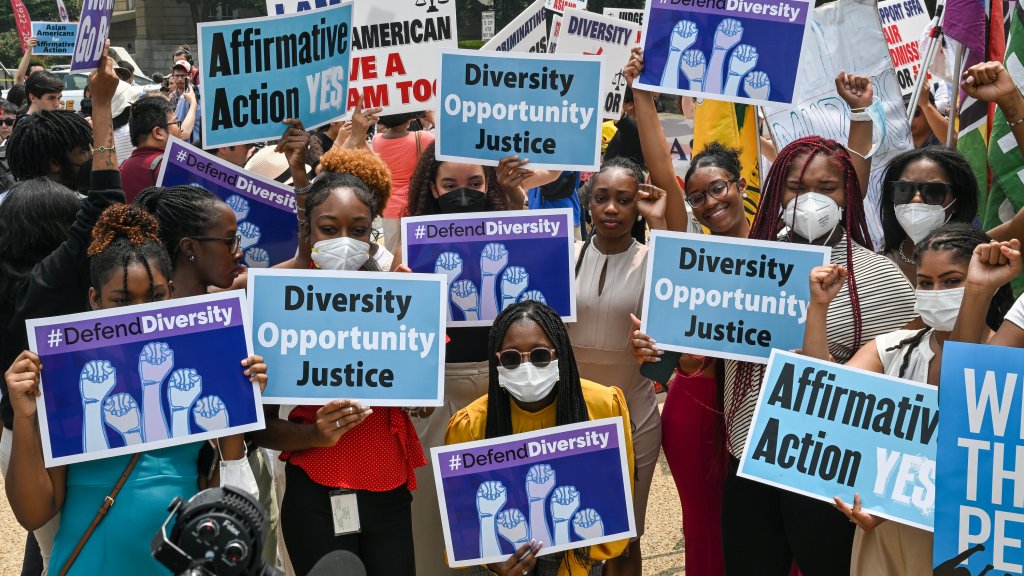
In June of 2023, the Supreme Court deemed it unconstitutional to acknowledge race in university admissions. This law, known as affirmative action, began in 1961 and was initially created to eliminate racial inequality, but it later grew into something much bigger and, up until this year, influenced how various schools in the United States accepted students. The Supreme Court first heard two cases in October of 2022 by the Students for Fair Admissions organization (SFA). This non-profit membership group against racial consciousness in colleges challenged the lawfulness of affirmative action at Harvard University, as well as at the University of North Carolina. They argued that it was illegal under the 14th Amendment’s Equal Rights provision. The ultimate verdict to ban affirmative action was decided under the basis that this rule violated the equal-protection clause under the U.S. constitution. This essentially ensures that all people of the United States cannot be discriminated against without fair reason, and that no laws can be made to counter that.
This decision made by the Court sparked immense controversy. NYU law professor Deborah Archer spoke on the matter, expressing her discontent with the new law. “Affirmative action and race conscious admissions policies helped address our country’s long history of racial discrimination and systemic racial inequality by increasing access to higher education for underrepresented racial and ethnic groups.” She basically contended that affirmative action is vital to increasing the opportunities for students of color and that ignoring race does not cause racial discrimination to disappear.
Students in highschool were also interviewed about the topic. A lot of them conveyed the same feelings. “White people tend to have a lot of institutional factors benefiting them that make it easier for them to succeed, therefore, on average, one can assume that a person of color probably had to try harder to reach the same level due to institutional disadvantages,” said one student from St. Peter High School. Another scholar believed that campuses should be diverse, but not at the detriment of hard work put in by all students.
People against affirmative action and therefore supporters of the recent laws believe that it is unfair to give minorities “special” treatment and reason to believe they do not need to try their hardest to do well. Other reasons include that it pins races against one another, or that there are already laws in place to prevent discrimination, making the use of affirmative action unnecessary.
One common misconception about the subject at hand is that White people are the only race opposed to the admissions policy; in fact, Asian Americans are also a proponent. Many Asian applicants for colleges have felt attacked by affirmative action, stating that there is a stigma around all Asian people being privileged. One student that was questioned was Alex Chen: a now 20 year old interviewed as a senior in high school. As an “ideal” Asian-American himself, Chen voiced his opinions on the subject. He said he understood why it was in place and why it was important for many minorities. However, he also spoke about how his hard work should count just as much as anybody else’s. This was true for a lot of Asian-American students that were also interviewed – they all agreed that they shouldn’t have to be “punished” for their achievements.
The fight against affirmative action is still ongoing for Students for Fair Admissions. This past week, they filed a lawsuit against the United States Naval Academy accusing them of using race in its admission decisions process. SFA stated it was unconstitutional to consider one’s race while selecting midshipmen. Just last week, SFA also brought up the same complaint against West Point, another U.S. military academy. There was some ambiguity on if military academies were exempt from the ban on affirmative action, but SFA believed it to be unjust nonetheless. The military however has upheld that having a diverse force is crucial to the nation’s security. The Naval Academy has yet to make comments on the lawsuit, and the case at West Point is relatively the same with it having yet to be addressed.
Though a simple matter to understand, it is hard to find a consensus on affirmative action. There is still much to debate and decide but one thing all people can agree on is that it is important to find that common middleground where all students have the support they need to be set up for success.
Sources:
- https://www.nytimes.com/2019/08/28/magazine/where-does-affirmative-action-leave-asian-americans.html
- https://www.usatoday.com/story/news/education/2023/10/05/us-naval-academy-annapolis-affirmative-action-lawsuit/71076734007/
- https://www.nyu.edu/about/news-publications/news/2023/june/what-happens-if-the-supreme-court-bans-affirmative-action-.html
- https://www.theguardian.com/law/2023/jun/22/what-is-affirmative-action-supreme-court-explainer
- https://www.navytimes.com/news/your-navy/2023/10/06/naval-academy-sued-over-affirmative-action-admissions-policy/
- https://www.nytimes.com/2023/09/21/learning/what-students-are-saying-about-the-end-of-race-based-affirmative-action-in-college-admissions.html