
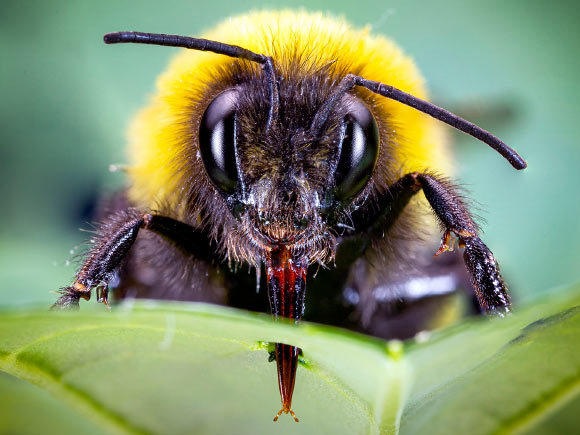
Recently, a study at the University of Guelph in Canada revealed a find that’s simply un-bee-livable. Bumblebee queens can survive underwater!
This discovery came about completely by accident. Ecologist Sabrina Rondeau was initially researching the effects of pesticides on eastern bumblebees. Part of her study included keeping hibernating queen bees in refrigerated tubes of soil, to replicate the conditions of their regular hibernating environments. However, when Rondeau went to check on her bees, she was terrified to find that some of them had been submerged in water due to condensation. To her surprise, instead of dying, the bees recovered and began to crawl around after being removed from the water.
Following this, Rondeau, working with environmental scientist Nigel Raine, carried out a large-scale experiment. They put 143 eastern bumblebee queens in refrigerated tubes filled with soil, then filled the tubes with varying amounts of water. Following this, the test tubes were left for various time allotments. After the allotted time (eight hours, 24 hours, or a week) had passed, the bees were taken out and returned to their normal hibernation conditions.
Rondeau and Raine found that the bees that had been submerged in the water recovered very well. Even the bees that had been in the water for a whole week had survival rates that weren’t far off from that of the control group. While the researchers don’t yet have an explanation as to what allowed them to survive, this find is in keeping with what’s currently understood about bumblebee hibernation cycles.
At the end of fall, worker bees and male bees die off. The queen bumblebees go into hibernation, which typically lasts around eight months. To protect themselves from the cold, they burrow into the ground. Once spring arrives, the queens emerge to start new colonies.
It’s possible that due to the likelihood of flooding in the underground burrows, bumblebee queens have evolved to be resilient to submersion in water. This could be due to them being in something known as diapause; a state where their body functions are essentially suspended. During diapause, the bee’s respiratory openings can close to prevent water from entering their bodies, as well as allow them to breathe through their skin.
Being aware of this could change scientist’s approach to bumblebee conservation. As conditions from climate change increase periods of flooding, scientists may not have to worry too much about how the hibernating bees will be impacted, and instead focus on other aspects of protection for the declining species.
The results of this study indicate that there’s still a lot we don’t know about bumblebees. Despite their critical role in the ecosystem, their nesting and overwintering habits are largely under-researched. Luckily, that’s starting to change. Discoveries like this one are allowing us to gain even more knowledge about fuzzy pollinators. Now that’s what I call the bee’s knees!
Sources
https://www.cnn.com/2024/04/17/americas/bumblebee-queen-underwater-scli-intl-scn/index.html

NAVA TABATA
- NAVA TABATA

- NAVA TABATA

- NAVA TABATA

- NAVA TABATA

- NAVA TABATA

- NAVA TABATA

- NAVA TABATA

- NAVA TABATA

- NAVA TABATA

- NAVA TABATA

- NAVA TABATA
- NAVA TABATA

- NAVA TABATA

- NAVA TABATA

- NAVA TABATA

- NAVA TABATA

- NAVA TABATA
