
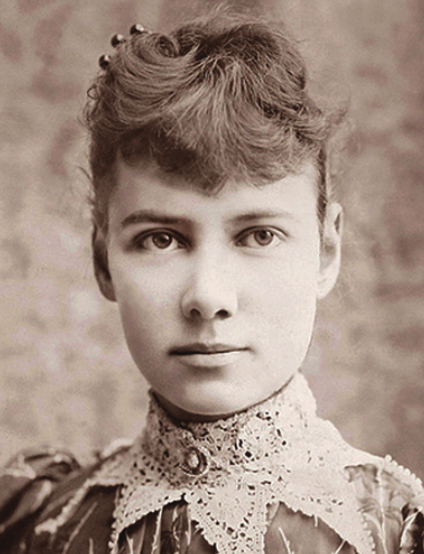
Over 130 years ago, a pioneer in investigative journalism faked her way into an insane asylum, exposing the horrible conditions within and spurring a wave of public outcry. This is the story of the trailblazing journalist Nellie Bly’s famous exposé.
Nellie Bly’s journalism career was born in 1885, after the Pittsburgh Dispatch published a column titled “What Girls Are Good For”. The article called working women immoral, and declared that a woman’s only role was in the home as a mother. Bly, then only 20 years old, was outraged, and wrote an anonymous letter to the newspaper that called out the article. Her letter expressed frustration at the lack of opportunities for women, and criticized the columnist for lacking an understanding of what working women experienced. The editor of the Pittsburgh Dispatch was impressed by her work, and offered her an opportunity to work at the paper. From there, Bly continued to grow her career.
While Bly’s writing evolved, and her audience grew larger, the same spirit from that very first letter stayed consistent within her later works. She dedicated herself to covering topics of women’s rights, the welfare of workers, and corrupt systems. Her stories approached these topics from a social justice angle. One of the best examples of this is her asylum exposé.
In 1887, Bly left Pennsylvania for New York. She struggled to find a job because the majority of newspapers refused to hire women. Eventually, she was hired by the New York World. Her first assignment was to investigate reports of mistreatment at the Women’s Lunatic Asylum on Blackwell Island by getting admitted as a patient.
Bly first started her assignment by practicing what it looked like to be “crazy”. After sufficiently preparing, she checked into a boarding house, where her behavior alarmed other boarders enough that she was sent to Bellevue hospital for evaluation, then to the Blackwell Island asylum. At the asylum, she completely dropped the act of insanity but found it made little difference in how she was treated. In one of her articles, Bly compared the asylum to a rat-trap, writing that “it is easy to get in, but once there it is impossible to get out.”
During the ten days she was at the asylum, Bly bore witness to the terrible conditions that patients were subjected to. She found all of the prior allegations to be true. The food that was served was horrendous. She, along with everyone else, was made to sit for hours without talking or moving. Nurses and caretakers were abusive and cruel to the patients, in some instances even choking them and giving them black eyes. Some patients required more serious care than they were able to receive. Most were from working class or immigrant families that had been left with very few options outside of going to the asylum. Bly’s writing explained the fundamental issue at the root of the institution, asking “what, excepting torture, would produce insanity quicker than this treatment?”
There was no way for patients to prove that they were fit to leave the asylum. No matter what they said, everything they did would be taken as a sign of insanity and a justification to keep them locked away for longer. Bly was able to leave due to someone from the New York World coming to get her, but the majority of the women she talked to did not have that chance.
Once she was out, Bly wrote multiple articles exposing the conditions she had seen at the asylum. They were later compiled into a book, titled Ten Days in a Mad-House. Her writing quickly became a sensation. It resulted in a public push for reform, which caused the asylum to be investigated, and implemented change.
Beyond the Blackwell island asylum, Bly’s book opened up conversations about how marginalized members of society were treated. Her works led many people to question what the fundamental purpose that such institutions actually served was. It was a call to rethink how quickly society could dismiss people as “insane” and deem them unworthy of fair treatment. While Bly’s work didn’t singlehandedly dismantle the existence of insane asylums, she changed the conversation surrounding them, and her writing carries relevance in the discussion of mental health issues and current medical institutions, even in present times.
Today, Nellie Bly’s story serves as a reminder of the critical role journalists play in dismantling corrupt and unjust systems. Her groundbreaking work paved the way for later investigative journalism. Bly’s legacy is one that endures, over a century after her death.
Sources
● Nellie Bly | National Women’s History Museum
● Nellie’s Milestones | American Experience | Official Site | PBS
● “Behind Asylum Bars:” Nellie Bly Reporting from Blackwell’s Island. | Headlines &
Heroes
● How Nellie Bly became a Victorian sensation and changed journalism forever –
Vox
● The Story of Nellie Bly, the Brave 19th-Century Journalist Who Went Undercover
to Expose Abuses at an Insane Asylum – American Essence

NAVA TABATA
- NAVA TABATA

- NAVA TABATA

- NAVA TABATA

- NAVA TABATA

- NAVA TABATA

- NAVA TABATA

- NAVA TABATA
- NAVA TABATA

- NAVA TABATA

- NAVA TABATA
- NAVA TABATA

- NAVA TABATA

- NAVA TABATA

- NAVA TABATA

- NAVA TABATA

- NAVA TABATA

- NAVA TABATA
