
Editor’s Note: Any opinions expressed in City Voice articles are the authors and do not imply that the City Voice takes a stand one way or another.
One of the most crucial questions to ask in today’s global economy is what medium of currency is being used. Because once we answer that, we can answer the underlying question: who really has the influence and power in international trade?
A couple of years ago, before the pandemic hit, the answer was clear to everyone: the dollar. From the years 1999-2019 (20 year period), the dollar reigned supreme. Approximately 83 percent of all foreign trade around the globe (excluding Europe) was transacted with the United States dollar.
Furthermore, the dollar was dominant in foreign exchange reserves, averaging about 65 percent over the same time period of 1999-2019.
Figure 1: Shares in exportation invoicing

Source: IMF Direction of Trade; Central Bank of the Republic of China; Boz et al. (2020); Board staff calculations (accessed on the Federal Reserve).
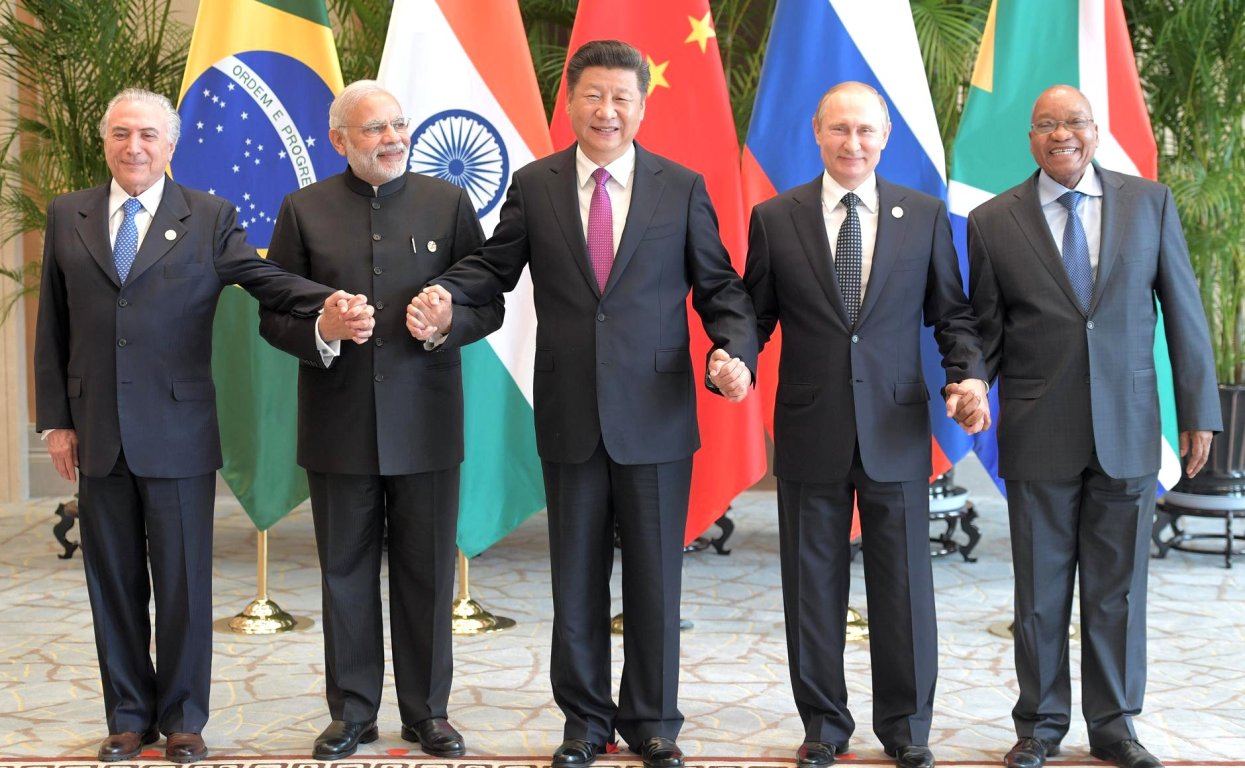
However, as COVID-19 surged worldwide, confidence in the dollar, as well as in almost every single other currency, was eroded substantially. This resulted in a plethora of efforts to restore the dollar’s value. Nevertheless, during the pandemic, BRICS (acronym for Brazil, Russia, India, China, and South Africa), an international bloc of countries aiming to dedollarize foreign trade, was emboldened even further since its establishment in June 2009.
This has raised speculation from many about the long-term financial life the dollar may have in foreign economic affairs.
Recent events have not done much to dispel these thoughts. In October of last year, Russia held a BRICS summit in Moscow, and they pledged to increase AI technology research and development. This was also speculated to further Russia’s war in Ukraine.
Moreover, the BRICS bloc has increased substantially, with six new nations joining just this month: Argentina, Egypt, Ethiopia, Iran, Saudi Arabia, and the United Arab Emirates (UAE). This has begun to play out more and more influence on the global stage, as more and more countries attempt to join the group.
Figure 2: Map of BRICS member countries

Source: Interactive Brokers 2025
As more countries have joined, it has begun to mean that more currencies are being used in efforts to counter the dollar, meaning that BRICS political expansion is necessary for practical reasons. It would be logically impossible to be able to counter the dollar if there were only a few member countries – and currencies – to counter such a large force in today’s global market.
However, it is vital to highlight the significance of the actuality of BRICS growth. Many circumstances that the United States has entail key advantages that makes it substantially more difficult for BRICS nations to be able to escape their confines to the dollar.
For example, the US has imposed multiple, heavy sanctions on a large portion of BRICS member nations, most notably Russia, Iran, and China.
These sanctions have entailed restrictions on its primary goal: money. In 2024, 70% of Russian bank assets were frozen, along with 350 billion US dollars worth of Russia’s foreign currency reserves.
Similarly, US sanctions on Iran have also been focused on restricting economic stimulation and interactions with Iranian financial institutions. Moreover, other target areas of US sanctions aim to target its crucial sectors, such as energy and technology. Because of Iran’s strategic location in the Middle East, it is crucial for the US to be able to effectively counter it.
Lastly, China has been faced with numerous sanctions from the US, including many goods on the Entity List, a list of companies that have heavy restrictions on purchasing from the United States, established by the Chamber of Commerce. This has been key for the US to be able to effectively counter China.
Figure 3: Map of US sanctions

Source: Dow Jones 2024
All of these restrictions have given the US an upper hand in one of the most important methods of preserving the dollar’s dominance in the global economy: leverage.
This sort of leverage the United States has is crucial, and is a clear indication that BRICS isn’t at the level of low dependence on the dollar that it hopes to be. This leverage can and has been played out in many forms.
Firstly, the US has created economic pressure on BRICS members. Because of the dependency they have on the US (the very thing they are attempting to diminish), and the fact that the US has imposed sanctions on them, they simply don’t have the means to be able to dedollarize. This pressure disallows them from using other financial channels to be able to use another currency of medium than the dollar. This has proven to be a primary reason why the dollar, despite its many challenges throughout the past few years, still remains relatively strong.
Also, these sanctions have begun to financially isolate BRICS members from economically engaging with the rest of the world, which is why, even today, we can see these same countries rely on each other for matters, even those outside of economic assistance. This is a slow but sure way of ensuring that the US can properly prevent decentralization of the dollar.
It is also important to note that a vast majority of private and public debt is denominated in the dollar, making it all the more difficult for those countries to be able to shift to local currencies in a timely manner.
Another key reason that the US has the upper hand in their cause for the dollar is because of possible retaliatory measures. If BRICS members continue to attempt to decrease reliance on the dollar, the US can place even further pressure, or even more sanctions, on them. In fact, Donald Trump has already threatened a 100% tariff on these countries. In our new post-COVID era, economic retaliation has begun to be a key instrument of leverage for nations to use to assert financial superiority.
Furthermore, many commodity-dependent countries, like Argentina and the UAE, rely on manufactured products for a vast majority of their economy. However, much of this production and foreign trade is, yet again, used with the dollar as the bartering medium.
Another way these commodity-dependent economies can negatively impact desired competition with the dollar is because of domestic account surpluses. This is essentially where these countries, especially Russia and China, produce so much product that people don’t actually need all of that, hence the emphasis on foreign trade and export. This is a primary reason so much of international natural gas comes from Russia, and why so many products come from China (other than inexpensive labor) and other countries in BRICS.
While this may seem like a good thing, it means that these nations are dependent on Western countries, who don’t produce as much, to buy their products. However, sanctions and other economic restrictions, as discussed previously, are all contingent on the US. One of the only reasons that their economies aren’t completely diminished is because the US, and other Western countries, have excessive consumer spending, almost doubling that of all BRICS countries combined. This spending takes up all of the extra products that BRICS countries produce, balancing out surplus in the East and shortage in the West.
Figure 4: American consumer spending vs. BRICS consumer spending

Source: World Bank 2024 (Accessed on Dunham Trust and Investment Services)
This dependency on the US, and therefore the dollar, is not in the best interests of BRICS, and is another reason why it isn’t (and can’t) making huge strides in dedollarization.
The above all displays that the dollar is crucial in today’s economy, and attempting to dedollarize will be costly and time consuming. These are key reasons as to why BRICS efforts to do exactly that aren’t taking the big steps like they had hoped, meaning that there is still hope left for the US dollar.
Sources
- https://carnegieendowment.org/research/2023/12/the-difficult-realities-of-the-brics-dedollarization-effortsand-the-renminbis-role?lang=en
- https://www.dunham.com/FA/Blog/Posts/brics-currency-flawed
- https://www.ccn.com/news/business/trump-tariffs-threat-brics-nations-de-dollarization/
- https://www.forbes.com/sites/anthonytellez/2023/02/08/here-are-all-the-us-sanctions-against-china/
- https://crsreports.congress.gov/product/pdf/IF/IF12452
- https://www.bbc.com/news/world-europe-60125659

AYAN SHUKLA
Ayan is the managing editor of the City Voice, and a current freshman at City High Middle. He primarily writes articles about the economy, politics, and global current events and won first place in his category in the 2025 MIPA awards. He is part of Speech and Debate, the NHS Executive Board, President of the Class of 2029, MYIG, MUN, Student Ambassadors, and started the Michigan branch of a nonprofit organization.
In his free time, Ayan enjoys playing the piano and the violin, reading, and excessively drinking coffee. You can contact him atshukla-a@students.grps.orgfor any questions about his articles.
- AYAN SHUKLA

- AYAN SHUKLA

- AYAN SHUKLA

- AYAN SHUKLA
- AYAN SHUKLA
- AYAN SHUKLA
