

Nosferatu has always faced controversy, from the original silent film to the contemporary horror film. Issues with Nosferatu: A Symphony of Horror (1922) started before production even began; the founders of Prana film, Nosferatu’s studio, tasked screenwriter Henrik Galeen with writing the film based solely on Bram Stoker’s Dracula even though they had yet to gain the film rights to said story. However Galeen still made changes to the original story, including names and locations, and most importantly, the effects that Count Orlok the vampire had on the German town.

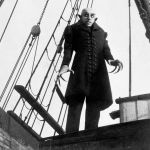
Nosferatu was partially intended to increase anti-Semitic feelings in post-WWI Germany, using Orlok as a means to draw out fear of “the Other.” Orlok is intended to look like a caricature of the Jewish people with a hooked nose, claw-like hands, and large, bald head. Orlok was also associated with creatures that Jews were compared to such as rats and mice. These parallels come to a head when Orlok brings a ship of plague-ridden rats that infect the town, associating Orlok further with the “disease bringing Jew” trope. This parallel has not gone unnoticed by scholars, with English professor Tony Magistrale saying, “[the] invasion of the German homeland by an outside force … poses disquieting parallels to the anti-Semitic atmosphere festering in Northern Europe in 1922.
The creators of Nosferatu also carried a concerning interest in the occult, which they incorporated into the film itself. The founders of Prana film, the studio that produced Nosferatu, created the studio with the intention of making many occult and supernatural themed films (this goal never came to fruition as Prana declared bankruptcy soon after Nosferatu’s release). One of the founders, Albin Grau, was an artist with a speciality in the supernatural. Grau took on the task of designing the set, costumes, makeup, and some of the props found throughout the film. One of the most notable props Grau created was a contract sent out by Count Orlok, signed by Mr. Knock. This contract featured many Hermetic philosophical thoughts surrounding the gods Hermes and Thoth — alchemical and Enochian (the constructed language of angels) symbols which caused tensions on the set of Nosferatu, as many cast and crew members felt they had signed up for more than they were prepared to handle as filmmakers.
Attitudes on set were not helped by the behavior of Max Schreck, who played the titular character of the film. Schreck did not care to spend much time with his coworkers, deciding instead to eat lunch by himself or just spend time alone. This behavior would not be considered off-putting or horrific currently, but remembering tensions in Northern Europe in this time and the fact that Schreck was playing the horrific character in this film, this idea makes a bit of sense. Rumors started to spread around set: people would say that Schreck secretly was a vampire and wasn’t acting at all, using the fact that he ate alone as a basis for this claim. This idea is, of course, absurd and those who knew Schreck would attest that he was just a humble actor who didn’t like attention, preferring the stage and taking hikes in the countryside. These ideas were not helped, however, by the fact that the most iconic and horrific shot of the entire film was done completely accidently. Specifics aren’t known, but the director and actors alike have said that this image was not intentional.

Legal troubles also arose after the release of Nosferatu, adding to the strange history and stigma surrounding the picture. The parallels between Nosferatu and Dracula did not go unnoticed by all, in fact Bram Stoker’s widow Florence herself noticed. Stoker took issue with her late husband’s work being used without permission or profit. Florence was only made aware of the film when a flyer was given to her for the Berlin premiere, which stated it was an adaptation of Bram’s work. Deciding to take matters into her own hands, Stoker sued Prana for their copyright violation. After some time in court, Stoker won and Prana was ordered to destroy all copies of the film. Prana agreed and destroyed all copies in their possession, but the film had already been sent out for international viewing. These international films are the only ones that survived, and any digital copy is taken from a French or English copy of the original film.

LINCOLN SCHNAARE
I’m Lincoln and I started at City in freshman year. I like to read and write, some of my interests include history, media, and media analysis. I like to craft - knitting and cross stitch are my best areas - and one of my favorite pastimes is casting the Muppets into different movies, TV shows, and books.
- LINCOLN SCHNAARE
- LINCOLN SCHNAARE
