
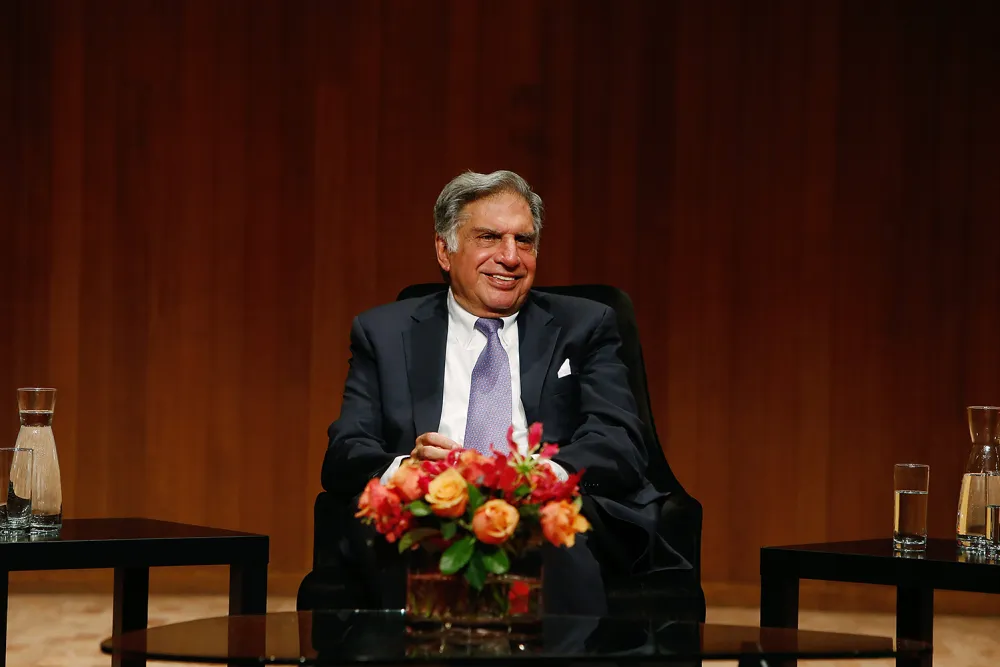
In February of 2018, Indian industrialist Ratan Tata was supposed to be honored with a prestigious award at Buckingham Palace, hosted by none other than King Charles III (at the time, Prince Charles). In recognition of his philanthropic work and contributions to the betterment of humanity, Tata was invited to attend the royal family’s ceremony and receive a lifetime achievement award.
Despite agreeing to be present at the event, he canceled his plans just days before, citing that one of his dogs had become ill. He said that, no matter how grand the ceremony was, he couldn’t leave his ailing, beloved pet behind. This act was just one example of his level of commitment, loyalty, and dedication to the people and causes that he truly believed in.
On Wednesday, October 9th, 2024, Ratan Naval Tata passed away at the age of 86 in his birthplace of Mumbai, India. At the helm of the business group launched by his great-grandfather, Tata is best remembered for using his position as chairman of Tata Sons and Tata Group from 1991 to 2012 to expand the company internationally, bringing it to over 100 countries. He is also known for his benevolent, charitable spirit towards social and humanitarian causes
Ratan Tata was born in Bombay (present-day Mumbai) during the British Raj in 1937. He was the son of Naval Tata, a member of the prominent Indian business family. He grew up with a younger brother, Jimmy, and a half-brother, Noel. Tata studied in schools across India before coming to the US and graduating from the Riverdale Country School in New York City in 1955. After high school, he received his bachelor’s degree in architecture from Cornell University in 1962.
Tata returned to India in the 1970s where he was given a managerial position in the Tata Group. The organization was originally founded in 1868 by his great-grandfather and famous entrepreneur, Jamshedji Tata. In 1991, J.R.D. Tata (Ratan’s uncle) stepped down as chairman of the group and named his nephew as the successor. Before Tata’s tenure, the leaders of each subsidiary of the Tata Group had heavy operational control over their departments; as a result, one of his first moves was to implement several policies that consolidated his power as the chief executive. Under his leadership, the company saw massive successes with expeditious global expansion. In fact, over the 21 years when he led the Tata Group, their revenue grew 46 times and the organization’s net profit rose 51 times compared to when he first took hold of the company.
To carry out his expansionist plan for the family business, Tata was behind several high-profile acquisitions. In 2007, Tata Steel purchased the British-Dutch Corus Group for $12 billion. The deal made Tata Steel the sixth-largest steel producer in the world and boosted the company’s global recognition. Just a year later, in 2008, when Ford Motor Company was on the brink of bankruptcy during the Great Recession, Tata Motors acquired Jaguar Land Rover from the American manufacturer for $2.3 billion. These purchases helped the Tata Group expand from a regional organization into an international conglomerate, with over 65% of the company’s revenue coming from operations in nations other than India.
Once he turned 75 in 2012, Tata stepped down from his position as chairman and resigned his executive powers over the Tata Group. However, after a leadership crisis ensued, he came back as interim chairman for a few months, from October 2016 to January 2017, until a permanent successor was appointed.
As a proponent of medicine, education, and rural development, Tata donated much of his wealth throughout his lifetime to various causes. He set up funds and accounts in several universities around the world to provide financial aid to students from India seeking a higher education, making him one of the leading philanthropists in India. His contributions have also been recognized by colleges who have named their schools after him, such as Tata Hall at the University of California, San Diego, Tata Hall at Harvard Business School, Tata Innovation Center at Cornell Tech, Tata Center of Technology and Design at the Massachusetts Institute of Technology.
In honor of his irrefutable love for animals, Tata’s last philanthropic venture was the Small Animal Hospital in his home city of Mumbai. The 98,000-square-foot facility was made open to the public in July of this year and now operates at full capacity.
Ratan Tata will forever be remembered for his acumen regarding business operations as well as his kind-spirited personality that promoted the betterment of the world. Whether it came to staying by his dog’s side in the toughest of times, improving his company’s international standing, or making higher education more accessible to the impoverished, he always prioritized the well-being of others before serving himself.

KRISHNA MANO
- KRISHNA MANO

- KRISHNA MANO

- KRISHNA MANO

- KRISHNA MANO

- KRISHNA MANO

- KRISHNA MANO
- KRISHNA MANO

- KRISHNA MANO

- KRISHNA MANO

- KRISHNA MANO

- KRISHNA MANO

- KRISHNA MANO

- KRISHNA MANO

- KRISHNA MANO

- KRISHNA MANO
- KRISHNA MANO

- KRISHNA MANO

- KRISHNA MANO

- KRISHNA MANO

- KRISHNA MANO

- KRISHNA MANO

- KRISHNA MANO

- KRISHNA MANO

- KRISHNA MANO

- KRISHNA MANO

- KRISHNA MANO

- KRISHNA MANO

- KRISHNA MANO

- KRISHNA MANO

- KRISHNA MANO

- KRISHNA MANO

- KRISHNA MANO
- KRISHNA MANO

- KRISHNA MANO

- KRISHNA MANO

- KRISHNA MANO

- KRISHNA MANO
- KRISHNA MANO

- KRISHNA MANO

- KRISHNA MANO

- KRISHNA MANO

- KRISHNA MANO

- KRISHNA MANO

- KRISHNA MANO

- KRISHNA MANO

- KRISHNA MANO

- KRISHNA MANO

- KRISHNA MANO

- KRISHNA MANO

- KRISHNA MANO

- KRISHNA MANO

- KRISHNA MANO

- KRISHNA MANO

- KRISHNA MANO

- KRISHNA MANO

- KRISHNA MANO

- KRISHNA MANO

- KRISHNA MANO

- KRISHNA MANO
- KRISHNA MANO

- KRISHNA MANO

- KRISHNA MANO
