

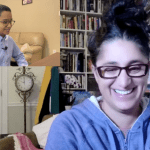
Just before the 2024 election, I was presented with the opportunity to interview Ghida Dagher, the president and CEO of New American Leaders. Her nonprofit organization is the only one in the nation that promotes immigrant and refugee involvement in the decision making process and empowers them to run for elected offices by providing them with the tools and resources that they need for a successful campaign. In just under half an hour, Ms. Dagher and I discuss her personal journey as an immigrant from Sierra Leone, the inspiration behind her work in public advocacy, and the impact that her organization has had on communities across the United States. If you prefer video to text, you can watch this interview using the following link: https://www.youtube.com/watch?v=2cKEzyflGzg
Interviewer: Could you please tell us about yourself, your journey to the United States, and what you do today?
Ms. Dagher: Of course. So I moved to the US when I was a couple months shy of 10 years old. My family and I came as refugees seeking political asylum when we arrived in the United States and we were escaping the Civil War in Sierra Leone. For background, I’m 100% Lebanese but third generation Sierra Leonean. I’m a first generation American and so I come from a line of immigration from place to place. My family left Lebanon seeking economic opportunity and strength as early as the 1800s. Of course, Lebanon was going through a tough civil war and then an invasion. Then, we left Sierra Leone because of another civil war and so it was very tragic and very sad, but we moved here and it was a big change for all of us. I have three siblings (we’re all four years apart each) and it became a very different time of our life – it was a really big adjustment for all of us.
Interviewer: As an immigrant who came here at a young age, what was something that you found difficult to adapt to in American culture that, at the time, was somewhat of a culture shock to you?
Ms. Dagher: There were a couple silly things and then a couple things that were a little bit more serious. Some on the silly front, or things that were more superficial, it was an adjustment to see people drinking from water fountains in school. Other places in the world don’t have clean drinking water and accessible water in the same way that we do here. I adjusted to an American education system in that my schooling was in a British system originally so I spelled everything with S’s instead of Z’s or O’s instead of U’s. Those were the slight adjustments, but on the deeper level, the biggest adjustment for me was that when you are an immigrant or a kid that comes from a traumatic experience like war, you come to the United States where folks who are born and raised here have lived in such safety, security, and stability. That’s such a privilege and, when you come from that background of instability or insecurity, the adjustment is a mental shift. My colleagues or my peers in my class maybe not understanding what I’m going through or what to them might seem stressful is not stressful to me. So it’s really a shift in a mind frame and that took a little bit to adjust to this idea of “Hey, we don’t have to run again for a while. We can be stable here and I don’t have to fear an attack or war of some sort.” It’s such a privilege to have that, whereas in other places in the world, not everybody has that.
Interviewer: How do you feel that other students in your class or your teachers accepted the shift or change that you were feeling? Were they more accepting of it or did they just not understand where you were coming from?
Ms. Dagher: I don’t think any of them were even remotely aware of what I was going through as a student. I think some of the teachers were and some of the teachers were not. I remember we were celebrating a kid’s birthday in class and somebody was upset that the cupcakes were vanilla instead of chocolate. That’s a big deal to you as a nine-year-old kid, of course, but not when you were coming from a different background. But, I was very fortunate to have a couple of really supportive teachers who understood the trauma and challenges that would come with being a refugee. We moved to a city called Dearborn here in Michigan when we were kids and the fortunate part of that is that Dearborn has a very large immigrant community. The school system was used to having immigrant kids and folks who are coming from different backgrounds so I felt like the school system was well adjusted and could address my needs for the most part. I will say, I was very fortunate because had I gone to an area like most refugees in this country where they might not be prepared for a lot of immigrants, they might have a much, much more difficult time. That’s one of the beauties of Michigan as a state: it’s very diverse and we have these really culturally rich pockets and communities across the state. We were fortunate enough to end up here and that was by choice from my parents because we had an aunt and uncle who were here. We knew folks that shared some of our cultural background and experiences and were here to support us through that change.
Interviewer: When looking at how these lived experiences from your childhood have affected your work today, could you please talk a little bit more about how your immigration journey has impacted your work at New American Leaders and what specifically your organization does?
Ms. Dagher: Yeah, New American Leaders is the only National Organization that’s training and preparing immigrants and children of immigrants, first- and second-generation Americans, to run, win, and lead in our democracy. That means everything from running for office, leading campaigns, or pursuing an appointment. That is all the work that we do to prepare them and advance them in that way and get them to see their own lived experiences as strong assets that are needed in our democracy. As an immigrant and a refugee myself, I have had a lot of these lived experiences and I often walked into rooms where I was the only or the youngest woman, or I’m the only Arab or the only immigrant in a room where policy decisions were being made. I often reflected and I thought to myself, “Why aren’t there more people that look like me and you who clearly come from immigrant backgrounds?” What would that mean for our democracy to have more of these folks in city halls or in Congress or at the Capitol? The more I advance in my work and in my professional career around policy and advocacy work, the stronger I feel about us needing more representation and having more conversations with people who can bring their lived experiences to the discussion. And when I say lived experiences, it’s things like issues that are everyday American issues that also impact immigrant communities: affordability of housing, good education, economic opportunity, small business, things that are so critical to our overall American economic health and the health of our democracy. It’s so important that ‘new Americans’ are a big part of our demographic as a country and it’s going to continue to significantly shift in the decades to come. There’s going to be a point where we will be a majority-minority country so for our democracy to keep up with the demands and the needs of its people, constituents, and citizens in a healthy and productive way, it needs more people like us to serve in office, lead campaigns, and be in appointed positions.
Interviewer: What exactly does New American Leaders do to help provide these resources for ‘new Americans’ who are seeking to hold an elected office?
Ms. Dagher: What we say is ‘Run, Win, and Lead’ in our organization, it’s three buckets of work. The ‘run’ work is this entire suite of training programs that prepares immigrants, children of immigrants, and grandchildren of immigrants to run for office or train them on the skill sets that they might need if they wanted to run for office. It’s everything from learning the nuts and bolts of a campaign to messaging themselves (they walk away with a stump speech that they’ve written if they were to run for office) to developing fundraising skills to learning from other elected officials who are also ‘new Americans’ and learning to not shy away from our identity, but lean into that as a big asset. All of our programs are designed by ‘new Americans’, for ‘new Americans’. There’s no turning a blind eye to who we are and most people will feel in politics that they have to sometimes turn the volume down on their personal identities or ethnic identities. We feel so strongly that you don’t need to do that; if anything, you need to lean into that because it makes you stronger, genuine, and authentic in your leadership. What’s for certain is that we need less generic buzzwords in our democracy and more reality, genuine voices, and authenticity overall.
Interviewer: When looking at the upcoming 2024 election, considering that it is a very contentious one up and down the ballot, what has New American Leaders been doing specifically for this election and how has the organization been empowering voters before this extremely important election for our democracy?
Ms. Dagher: You don’t always see the results of this kind of work immediately, it takes time and nurturing of our communities. We may train you, for example, and then you may not be ready to run for another couple of years so sometimes it takes a little bit more time while others may say “Hey, I’m ready to run now! Teach me everything because I’m ready to go.” In this election, I’m really proud of the fact that we have 83 alumni running for office across the country in 16 different states at nine different levels of office. I get so excited every time I think about it – look, I’m cheesing just thinking about them – and almost 60% of those people that are running are women which is so important as well. 98% are (Black, Indigenous, and people of color) and 15% are LGBTQ so there’s great diversity within our alumni who are running. These are, again, from local school boards all the way to members of Congress so it shows that our network is effective and our work is important. Hopefully, on the day after election day in November, when we wake up, we have 83 newly elected officials who are ‘new Americans’ so we’re really excited for them.
Ms. Dagher: Then, with the New American Leaders Action Fund (which is our sister organization that’s a little bit more political), we have 49 candidates that we’ve endorsed and close to 45% are also women running for the State Legislature in particular. It’s such an important need across the country right now to have more women running for office, but, in particular, in state legislatures so I’m very excited about our endorsees that are putting themselves out there and really trying to change the face of our democracy everywhere in this country. Of course, behind every campaign is a whole lot of people who are the force behind the everyday organizing and the volunteering. And then, the other side of this is getting people out to vote. It’s so important to the single, fundamental first step of civic engagement which is voting, so it’s so important that everybody takes advantage and utilizes that right that they have to actually get out and vote. So we’re doing a lot of GOTV which means Get Out The Vote for getting folks organized and reminding them that they could do early voting, making sure they know where their polling locations are, and making sure that they understand that everything from the president of the United States to school boards are on the ballot, and very important decisions are made at each and every single one of those levels. This is our opportunity for our voices to be heard and so, in the same way we want more ‘new Americans’ to run, we want more ‘new Americans’ to vote.
Interviewer: When looking at specifically how important this election is, I came across this article recently from the Pew Research Center from September of 2023 that said that America is the most polarized that it’s ever been in history. Do you think that this increased representation of immigrants and minority groups in modern-day politics can actually help reduce the extreme polarization and divide that we see today in our country?
Ms. Dagher: Absolutely, I think that it can lend to that tremendously. I think the more that we are able to be in those spaces, the more that people understand not only us, but the issues that we face. I think it’s very easy to pin people against each other in politics and say “Oh, this person is advocating for higher wages because the employees are greedy” and for the employees to say “Well that employer is greedy and they don’t want to pay us more.” But, when we’re sitting together at a table to have a conversation, we can talk about the challenges on either end and how we can come up with a long-term plan to get both fair wages for workers and also ensure that businesses are able to stay in business. That’s one example of what that means, so it’s really important that we are bringing our full selves, not diluted versions of ourselves; our democracy, overall, is healthier when there’s more conversation and there’s more representation.
Ms. Dagher: If you have one monolith of a voice in a room, then the results are going to just serve that one group of people, it’s not going to serve the overall good of the public. These entities, these institutions, these places of power are meant to serve all folks and so you want to ensure that our voices are there. We do a report every two years at New American Leaders called the State of Representation and it measures the parity of state legislators with how much they represent ‘new Americans’ and how many people are in office that are ‘new Americans’. And we’re not at parity, there’s definitely a disparity there in almost every single state. But, there is incremental growth that is happening and it’s really good; I will say that, between 2022 and 2024, we’ve seen an increase of 20% in representation and those states that have more representation are healthier, more productive, and are able to accomplish more and address the needs of their constituents more.
Interviewer: This election is about to come in just under two weeks now, so when looking further into the future, what work is left to be done to include the experiences of these ‘new Americans’ in both our civil and political society?
Ms. Dagher: I think, on the political front, this is work that has to continue. It’s a long-term investment and it’s building year after year after year, so it’s safe to say our work is not done after the election. You have to think about it like building blocks: you can’t build a house by laying one brick and say “Oh, we’re done.” You have to lay more bricks and then layers upon layers upon layers. If this is your first time voting, how do you build on that? What does that look like next? Is it volunteering on campaigns? Is it taking your family members? Is it eventually running for office or working on a campaign? For us as an organization, as New American Leaders, layering means training more people in more corners of this country in more levels of government, reaching new heights in what we’re able to accomplish. It’s also investing a lot on the research front so we can measure the impact of the work that we’re doing and the impact of ‘new Americans’ in office. Here in Michigan, you have multiple ‘new Americans’ who are just phenomenal leaders, everybody from State Senator Stephanie Chang to State Representative Ranjeev Puri to State Senator Darrin Camilleri. We have phenomenal folks who are taking on really big issues and I want to see more of us do that, not just in Michigan but everywhere across the country.
Interviewer: Thank you so much. And to end this interview on a lighter note, you’ve previously said that, in an alternate universe, you would want to be a travel photojournalist. What is the inspiration behind this dream career?
Ms. Dagher: I see beauty in a lot of people and I see beauty in a lot of different places. Often, we overlook those because our lives are so fast-paced and we don’t take time to really absorb the small, beautiful things in life. I also think the United States is so big and many Americans prefer to travel here or feel that things are so far and can’t be reached or sometimes we just don’t have means as people to go see these places. I think photojournalism is such a beautiful way to capture the world and to ignite imagination and hopes for travel and dreams, but also familiarize yourself with other people. I think there’s so much at our core as people that brings us together than divides us and we create some of our own divisions by choice. When you travel and see the world, you learn that in such a tangible and real way and so photojournalism is a way to share that with people.

KRISHNA MANO
- KRISHNA MANO

- KRISHNA MANO

- KRISHNA MANO

- KRISHNA MANO
- KRISHNA MANO

- KRISHNA MANO

- KRISHNA MANO

- KRISHNA MANO

- KRISHNA MANO

- KRISHNA MANO

- KRISHNA MANO

- KRISHNA MANO

- KRISHNA MANO

- KRISHNA MANO
- KRISHNA MANO

- KRISHNA MANO

- KRISHNA MANO

- KRISHNA MANO

- KRISHNA MANO

- KRISHNA MANO

- KRISHNA MANO

- KRISHNA MANO

- KRISHNA MANO

- KRISHNA MANO

- KRISHNA MANO

- KRISHNA MANO

- KRISHNA MANO

- KRISHNA MANO

- KRISHNA MANO

- KRISHNA MANO

- KRISHNA MANO
- KRISHNA MANO

- KRISHNA MANO

- KRISHNA MANO

- KRISHNA MANO

- KRISHNA MANO

- KRISHNA MANO
- KRISHNA MANO

- KRISHNA MANO
- KRISHNA MANO

- KRISHNA MANO

- KRISHNA MANO

- KRISHNA MANO

- KRISHNA MANO

- KRISHNA MANO
- KRISHNA MANO

- KRISHNA MANO
- KRISHNA MANO
- KRISHNA MANO
- KRISHNA MANO

- KRISHNA MANO

- KRISHNA MANO

- KRISHNA MANO

- KRISHNA MANO

- KRISHNA MANO

- KRISHNA MANO

- KRISHNA MANO

- KRISHNA MANO
- KRISHNA MANO

- KRISHNA MANO

- KRISHNA MANO
