
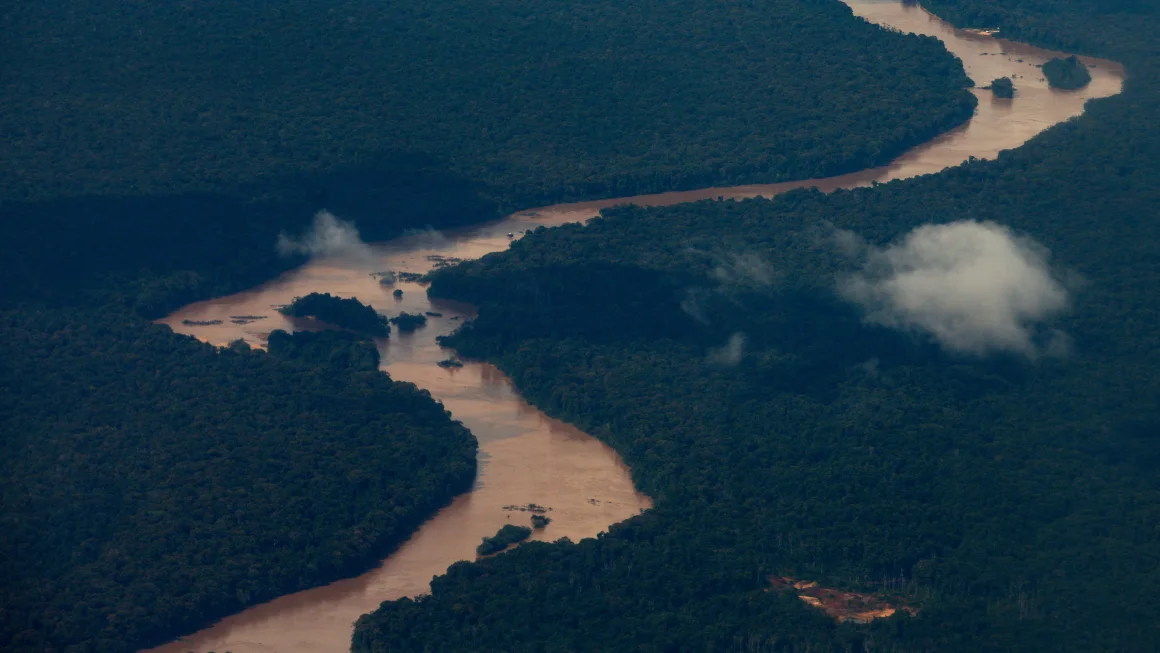
Venezuelan President Maduro has his eyes on the Essequibo region in Guyana, an area filled with rich oil reserves. Both nations could invest in the oil in Essequibo and make tremendous profits. The issue, however, is the unsettled border between these two nations. The increasing military presence between Venezuela and Guyana and rising tensions call for a desperate solution.
For nearly two hundred years, the neighboring countries Venezuela and Guyana have disputed their border. Before the 19th century, both countries were colonized by European nations. Venezuela was colonized by Spain. Around the 16th century, Sir Walter Raliegh discovered the area of Guyana, and the Dutch established three colonies around the region in the 17th and 18th centuries. When Venezuela gained independence from Spain in 1811, the border between these Dutch settlements and Venezuela was never defined. The British captured these settlements in the Napoleonic Wars, and the settlements became the British Guiana. Venezuela made little attempt to explore their region around the British Guiana. However, Robert Schomburgk explored much of the physical geography of British Guiana, and later he and his brother created the “Schomburgk line.” This line marked that the British Guiana would span from the western territory of the Essequibo River up and include the Orinoco delta.
Venezuela denied the Schomburgk line since it was drawn on behalf of Britain. Venezuela claimed that the real border would be the Essequibo River (pictured below). Britain offered to modify the Schomburgk line by establishing the border at the mouth of the Orinoco River (pictured below). This offer was denied. This was the start of a slew of unproductive legislation. The next few decades followed with Venezuela insisting that the Essequibo River would be the defining border, with the British holding on to the amendment of leaving the Orinoco mouth. The Schomburgk line was the implied border during these disputes.

In 1887, Venezuela finally severed diplomatic ties with Britain over the border issue. The country turned to the US to help resolve this issue. The US offered its good offices, or its third-party willingness to assist in the diplomatic measure, but Britain rejected this. Venezuela eventually succeeded in getting US arbitration, however, and the US sided strongly with Venezuela and asked Britain to reconsider the border. Cleveland, the president of the US at the time, was very adamant about Venezuela’s justice, which shocked British Prime Minister Lord Salisbury. Tensions began to escalate as the solution to this dispute was delayed and talks of war occurred. However, war did not occur, and the US took over in arbitration for Venezuela. US and British ambassadors finally agreed on an arbitration tribunal in 1899. The British asked that all the territory west of the Essequibo river would belong to Britain, but would give the Orinoco river delta to Venezuela. The US government eventually agreed to this, knowing that Britain would not give up more land for Venezuela. This would mark the arbitral tribune award for the Venezuela-Guyana Border Dispute and would solve the issue for a few decades.
In 1962, the British Guiana won its independence and renamed itself to present-day Guyana. With this independence, Venezuelan President Rómulo Betancourt decided that Venezuela would claim two-thirds of the state. This proclamation declared the 1899 arbitral tribune award null and void, and thus the border dispute was sparked again. The president accused the US arbitrators of being biased toward Britain. Now that Guyana had gained its independence, it was time for a border change. Since the border had been contented for decades, new forms of agreement were made in Geneva in 1966. Venezuela and Guyana agreed that all claims would be suspended until a Venezuela/Guyana mixed council would make a definitive decision within four years. Yet, the council did not come up with a solution in these four years. So in 1970, Venezuela and Guyana agreed to pause the dispute for twelve years. After these twelve years, Venezuela was urgent to make a negotiation for the ongoing, unproductive dispute. Guyana did not want negotiations and proposed that the dispute would be resolved by the International Court of Justice (ICJ), or the UN General Assembly or Security Council. Venezuela disagreed with this. The two countries, unwilling to compromise, left the dispute to the UN Security General. Present-day, the ICJ, and the UN Secretary-General have power in this decision.
The border dispute, left meddling by the two nations, is now a topic of contention once again with the discovery of oil in the Essequibo region by Exxon Mobil in 2015. President Maduro quickly claimed the Essequibo region as his. Venezuela is already very rich in oil, but its oil economy has been crashing during President Maduro’s rule. Venezuela is in a time of poor health care, education, and economy, and taking advantage of the oil there could earn the country about $40 billion. However, the Essequibo region is in Guyana based on the 1899 Aribrital Award. This discovery would significantly increase the oil revenue for Guyana as well. This chase for revenue has driven rampant military increases from both Venezuela and Guyana. It has also driven up President Maduro’s increasing tension with Guyana. This is because he continues to cover up his poor leadership with the nationalism of claiming Essequibo to improve the oil economy. Continuing this border dispute has only escalated tensions, and the brink of war between Venezuela and Guyana could start anytime soon. This would destroy the lives of thousands of civilians, create a plethora of refugees, and be financially devastating. Also, Venezuela has a much stronger military than Guyana, making for devastating circumstances if a war were to occur.
Preventing a war between these two countries has been an important agenda for the international community. The border dispute has been ongoing for centuries. Venezuela and Guyana, the United Nations, and the International Court of Justice are continuing to make efforts to settle the unproductive disagreeemnt. For now, however, years of the inability to compromise from both countries and the abundant oil in the Essequibo region have led to increasing tensions and the frightening possibility of war.
Works Cited
John, Tara. ““Dangerous Game” as Venezuela Expands Military Buildup at Guyana Border, Says Report.” CNN, 14 May 2024, http://www.cnn.com/2024/05/14/americas/venezuela-essequibo-guyana-csis-intl-latam/index.html. Accessed 21 Oct. 2024.
Loader, Mandy. “Essequibo | History, Oil, Contested Territory, & Map | Britannica.” Www.britannica.com, Britannica, 9 Jan. 2024, http://www.britannica.com/place/Essequibo. Accessed 21 Oct. 2024.
Poole, Gregory. “The Situation in Guyana – GLICA.org.” Glica.org, GLICA, 4 Sept. 2024, glica.org/glimun/committees/the-situation-in-guyana/. Accessed 21 Oct. 2024.
Revista, CEBRI. “Notes on the History of the Venezuela/Guyana Boundary Dispute.” CEBRI Revista, CEBRI, Jan. 2024, cebri.org/revista/en/artigo/138/notes-on-the-history-of-the-venezuelaguyana-boundary-dispute. Accessed 21 Oct. 2024.
“Secretary-General Chooses International Court of Justice as Means for Peacefully Settling Long-Standing Guyana-Venezuela Border Controversy | Meetings Coverage and Press Releases.” Press.un.org, United Nations, 30 Jan. 2018, press.un.org/en/2018/sgsm18879.doc.htm.
Image
Loader, Mandy. “Essequibo | History, Oil, Contested Territory, & Map | Britannica.” Www.britannica.com, Britannica, 9 Jan. 2024, http://www.britannica.com/place/Essequibo. Accessed 21 Oct. 2024.

KENZIE LOW
- KENZIE LOW

- KENZIE LOW
- KENZIE LOW

- KENZIE LOW
- KENZIE LOW

- KENZIE LOW

- KENZIE LOW
- KENZIE LOW

- KENZIE LOW

- KENZIE LOW
- KENZIE LOW

- KENZIE LOW

- KENZIE LOW

- KENZIE LOW