
Editor’s Note: Any opinions expressed in City Voice articles are the authors and do not imply that the City Voice takes a stand one way or another.
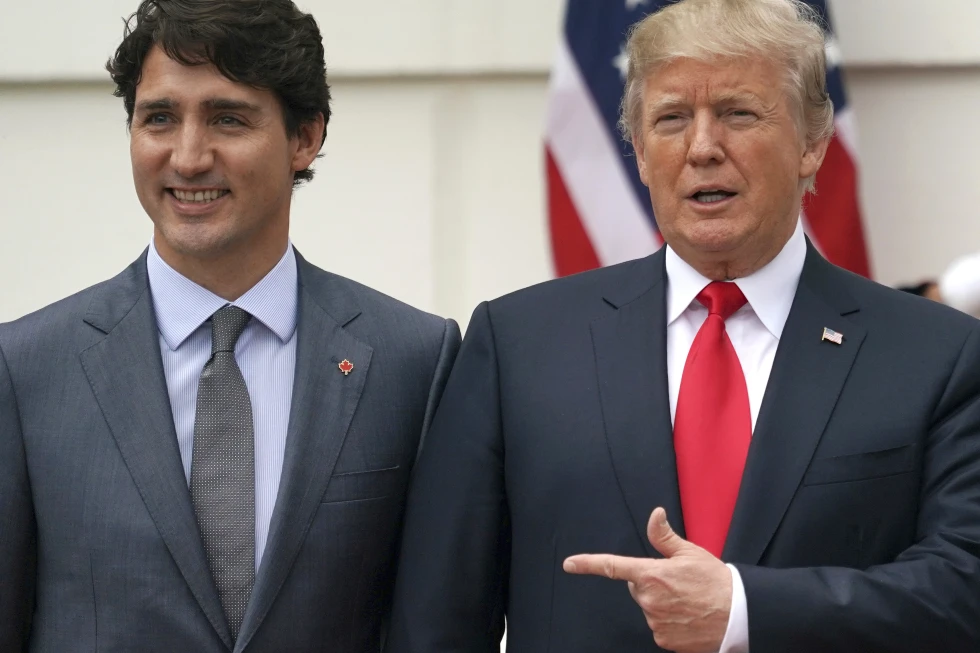
On January 7th, Trump threatened that the United States would annex Canada through economic pressure. This was not Trump’s first remark on annexing a region. Trump claimed that he would attempt to annex the Panama Canal as well. However, annexing a large neighbor and ally to the north may cause detrimental international relations.
Trump noted on his social media that “many people in Canada LOVE being the 51st state.” However, Canadian favorability towards the US decreased when Trump was in office, going down to 35% unfavorably. Favorability to the US slightly rose after Biden became president. Political polls also show that Canadians have a different political ideology compared to their American counterparts. An example of this is public health care being deeply rooted in their government, while American utilizes insurance companies. While Canada maintains a positive relationship with the US, Canada is strongly opposed to Donald Trump’s nationalist measures and losing its sovereignty. Prime Minister Trudeau said afterward on X, “There isn’t a snowball’s chance… that Canada would become part of the United States.”
The threats to annex Canada are apparently nothing new. In the War of 1812, Thomas Jefferson told newspaper editor Thomas Duane that “the acquisition of Canada… will be a mere matter of marching.” Later, the National Park Service notes that many Americans wrongly assumed that Canada would welcome US forces in their country. In the later 1800s, many political parties began to agree that Canada would welcome an annexation of their nation. This was an example of pure American nationalism. Canada, like virtually all nations, would not give up its sovereignty so easily.
The US does face trade deficits with Canada, a pressing issue for the US for not just Canada but many of its trading partners. Yet, maintaining a diplomatic relationship between the US and Canada has benefitted both countries greatly. Both countries provide greater national stability and defense to each other. The two countries are a part of NATO, providing security in wartime. Additionally, the trade between these two countries fuels competition and grows the economy of both nations, while allowing for essential resources to flow between the two lands. For example, Canada continues to be the greatest supplier of energy to the US as well. The US and Canada have partnered on many other issues, such as international issues (along with China), and climate change. The US and Canada have continued to enjoy one of the most productive relationships in the international community.
Trade deficits, along with Trump’s claim that the US is essentially spending too much money protecting Canada, have fueled his reasoning to annex Canada. Trump said “We don’t need their cars; you know they make 20% of our cars. We don’t need that; I’d rather make them in Detroit.” He also claimed that annexing Canada would be “much better for national security.” He wishes to get rid of the border, or as he called it, the “artificially drawn line.” Trump told Trudeau that Canada should be a US state since the US presidential elect claimed that the US subsidizes Canada with $200 billion in trade, and pays much more for Canadian military defense, suggesting that Canada had virtually no military. Trump had referred to Trudeau as a governor of the 51st state before the meeting, further increasing tensions. Trudeau after the meeting, was discontent with the motion.
Amid the talk of Canadian annexation, Trudeau recently announced that he would resign as the prime minister. He would step down as the leader of the liberal party when a new leader was decided. His fall was closely aligned with the announced resignation of his long-serving finance minister, Chrystia Freeland. The election would take place no later than October 20th.
Canadians look unfavorably upon Trudeau and the Liberal Party. The nation is facing increasing economic instability. To promote increased monetary circulation, the government had to temporarily eliminate the Goods and Service Tax among many purchasable items and services. Also, while Canada has always had an emphasis on multiculturalism, Canadians criticize Trudeau’s lenient immigration policies. His are closely aligned with many liberal immigration policies, which have been accused of increasing demand and raising prices by both Americans and Canadians.
The era of Trudeau’s rule had created increased polarization in Canada. Along with Trump’s advancements threatening Canadian sovereignty, political tension made it a challenge for Trudeau to continue as prime minister. On another note, the leading elect from the conservative party is Pierre Poilievre, who is more far right than any previous conservative leader. Many claim Poilievre has undergone a sort of ‘Trumpification.’
Domestic tensions along with Trump’s threats of annexation had led to increased political tensions in the two nations. It seems a challenge that the two nations maintain a competitive but cordial relationship during an era of American nationalism and domestic Canadian turmoil.
Works Cited
Bland, Scott. “Trump’s Annexation Talk Extends a Long U.S. Tradition of Political Miscalculation about Canada.” NBC News, 7 Jan. 2025, http://www.nbcnews.com/politics/donald-trump/trumps-annexation-talk-extends-long-us-tradition-political-miscalculat-rcna186625. Accessed 8 Jan. 2025.
Deliso, Meredith, and Julia Reinstein. “Justin Trudeau Says He’ll Resign as Prime Minister of Canada.” ABC News, 6 Jan. 2025, abcnews.go.com/International/canadian-prime-minister-justin-trudeau-resigns-leader-liberal-party/story?id=116837766. Accessed 8 Jan. 2025.
Gopnik, Adam. “Why Justin Trudeau Had to Step Down.” The New Yorker, 6 Jan. 2025, http://www.newyorker.com/news/the-lede/why-justin-trudeau-had-to-step-down. Accessed 8 Jan. 2025.
U.S. Department of State. “U.S. Relations with Canada.” United States Department of State, 19 Aug. 2022, http://www.state.gov/u-s-relations-with-canada/.Wilson, Mallory. “Donald Trump Says America Could Annex Canada via Economic Force.” The Washington Times, 7 Jan. 2025, http://www.washingtontimes.com/news/2025/jan/7/donald-trump-says-america-could-annex-canada-via-e/. Accessed 8 Jan. 2025.

KENZIE LOW
- KENZIE LOW

- KENZIE LOW

- KENZIE LOW

- KENZIE LOW

- KENZIE LOW

- KENZIE LOW
- KENZIE LOW

- KENZIE LOW

- KENZIE LOW

- KENZIE LOW

- KENZIE LOW

- KENZIE LOW

- KENZIE LOW

- KENZIE LOW