
Thumbnail: https://www.imdb.com/title/tt0050083/mediaviewer/rm2516156672/?ref_=tt_md_11
Movie: 12 Angry Men
Director: Sidney Lumet
Screenplay: Reginald Rose
Starring: Henry Fonda, Lee J. Cobb
Rating: Unrated
Run Time: 1h 35m
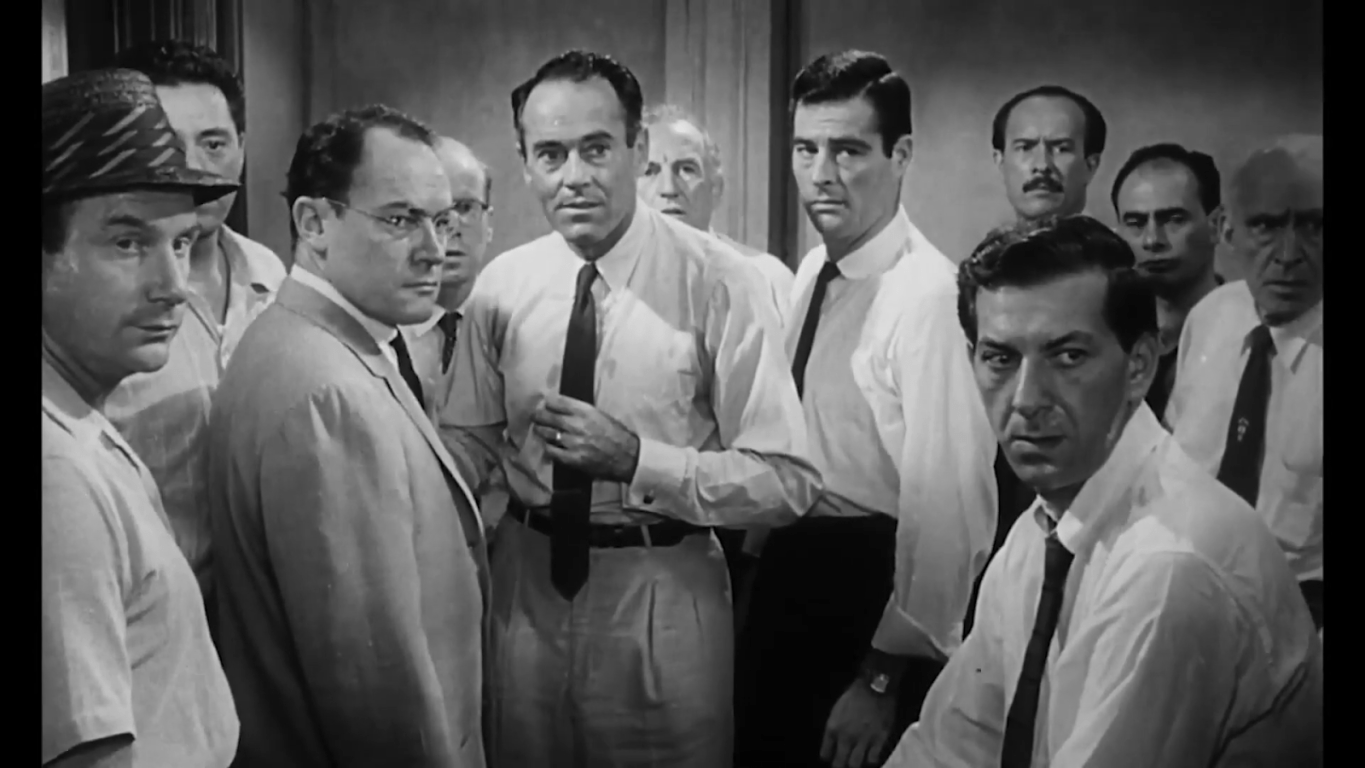
A small jury deliberating room in a New York courthouse. 12 jurors, each forced to question their once-perfect reasoning. And one case that draws the line between life and death for a defendant. The 1957 film 12 Angry Men, directed by Sidney Lumet, introduces the audience to a seemingly simple court case with a seemingly obvious verdict, yet proceeds to probe and examine every aspect (evident or not) of the murder presented in front of Juror 8 (Henry Fonda) and 11 fellow New Yorkers.
Adapted from Reginald Rose’s 1954 play by the same name, the plot follows 12 male jurors who follow various individual lives outside of the courtroom but find their beliefs to intertwine and vehemently disagree with each other throughout the story. The defendant in the case, who faces the death penalty as his punishment if he is found guilty, is an impoverished teenager who is charged with fatally stabbing his father. As one juror says as they enter the deliberation room, it could best be described as an “open-and-shut case”. As a result, 11 of the jurors find the evidence to be conclusive of proving that the defendant is guilty “beyond reasonable doubt”, a phrase that is ingeniously twisted by the 8th juror who attempts to define it while considering the impact his decision could have on a young man’s life.
Trailer: https://www.youtube.com/watch?v=_13J_9B5jEk
Rose’s script delves deeply into the jurors’ psyches, revealing their biases, personal struggles, and moral compasses. Each character is crafted to be distinct in both their backgrounds and viewpoints, making their interactions and conflicts all the more compelling. Among the various dissenters of the protagonist are a vengeful, short-tempered man who is reminded of his own son’s disobedience, a garage owner overflowing with a full tank of pride and even more racial prejudice, and a calm, yet highly egotistical stockbroker who is convinced that his opinion trumps all others.
Bringing the meticulously crafted script to life, Fonda’s portrayal of Juror 8 is nothing short of iconic. The character’s calm demeanor, logical reasoning, and unwavering sense of justice serve as the moral backbone of the film. His performance is understated yet powerful, setting the tone for the entire ensemble. On the contrary, Lee J. Cobb, as Juror 3, provides a perfect counterbalance with his intense and emotionally charged performance, representing the anger and prejudice that can cloud judgment.
The movie was cemented into legal film history by Lumet’s innovative direction. As the film progresses, the room feels increasingly claustrophobic, mirroring the mounting pressure on the jurors to reach a verdict. Lumet’s ability to maintain suspense and engagement, despite the film’s small, static setting, is a testament to his masterful direction.
12 Angry Men is more than just a courtroom drama; it is a powerful commentary on the American justice system, implicit bias, and the importance of standing up for what is right, even when it is unpopular. Despite the film being over 6 decades old, its underlying theme of prejudice outweighed by moral integrity is as relevant today as in 1957. As a timeless classic that resonates with audiences, it is a must-watch for anyone interested in the complex correlation between the pursuit of justice and the human condition. It isn’t merely an entertaining film but a cinematic masterpiece that reinstates the importance of principles and righteousness at a time when the world needs it most.

KRISHNA MANO
- KRISHNA MANO

- KRISHNA MANO

- KRISHNA MANO

- KRISHNA MANO

- KRISHNA MANO

- KRISHNA MANO

- KRISHNA MANO

- KRISHNA MANO

- KRISHNA MANO

- KRISHNA MANO

- KRISHNA MANO

- KRISHNA MANO

- KRISHNA MANO

- KRISHNA MANO
- KRISHNA MANO

- KRISHNA MANO

- KRISHNA MANO

- KRISHNA MANO

- KRISHNA MANO

- KRISHNA MANO

- KRISHNA MANO

- KRISHNA MANO

- KRISHNA MANO

- KRISHNA MANO

- KRISHNA MANO

- KRISHNA MANO

- KRISHNA MANO

- KRISHNA MANO

- KRISHNA MANO

- KRISHNA MANO

- KRISHNA MANO
- KRISHNA MANO

- KRISHNA MANO

- KRISHNA MANO
- KRISHNA MANO

- KRISHNA MANO
- KRISHNA MANO

- KRISHNA MANO

- KRISHNA MANO

- KRISHNA MANO

- KRISHNA MANO
- KRISHNA MANO

- KRISHNA MANO

- KRISHNA MANO
- KRISHNA MANO

- KRISHNA MANO

- KRISHNA MANO

- KRISHNA MANO

- KRISHNA MANO

- KRISHNA MANO

- KRISHNA MANO

- KRISHNA MANO

- KRISHNA MANO

- KRISHNA MANO

- KRISHNA MANO

- KRISHNA MANO

- KRISHNA MANO

- KRISHNA MANO
- KRISHNA MANO
- KRISHNA MANO

- KRISHNA MANO
