

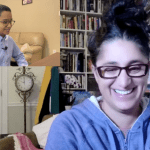
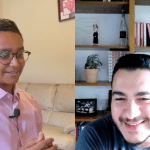
Earlier this year, I had the opportunity to interview Valarie Kaur, an activist, documentary filmmaker, and faith leader. She is the author of two award-winning books: See No Stranger and Sage Warrior. She is also the founder and director of the Revolutionary Love Project, a non-profit that equips everyday citizens with the resources and knowledge needed to lead mass mobilization efforts, specifically aimed at reclaiming love as a force for justice. Over the course of our conversation, Ms. Kaur and I discuss her Sikh religious background that molded her identity and purpose, her early days in social activism through visual arts, and her current mission and future plans regarding the Revolutionary Love Project. If you prefer video to text, you can watch this interview using the following link: https://www.youtube.com/watch?v=9l2NF12BASw
Interviewer: Could you please tell us about yourself and what you do today as a part of the Revolutionary Love Project?
Ms. Kaur: I speak about love, I write about love, I organize around love. For most of my life, as a civil rights activist, I have organized around hate. I have made a promise, a pledge, to spend the rest of my life organizing around love and that means that we are reclaiming what love is. Love is more than a feeling that comes and goes, ebbs and flows. Love is sweet labor: fierce, bloody, imperfect, lifegiving, a choice we make again and again. When we love beyond what evolution requires, when we love people who are in harm’s way, when we love even our opponents as we’re trying to fight for justice, when we love ourselves to keep us well in the labor, then love becomes revolutionary. This is what makes me so happy to speak with you because the last time we were together was on the Revolutionary Love Tour where we were taking this message to 45 cities all across the country. We are building a whole movement of people who are reclaiming love as a force for justice, healing, and transformation. To be here with you and to know that you are part of the next generation who are standing deeply in these values inspires me greatly and keeps me going in the labor.
Interviewer: Speaking to your background, despite your connections to Sikhism and Punjabi culture, you were born in California and grew up on a farm. How has your childhood as someone who practices a minority religion here in the United States shaped you as a person as well as with your work in activism?
Ms. Kaur: My grandfather sailed by steamship from Punjab to California in 1913 so the farmland that I grew up on were the fields that my grandfather and my father had farmed long before I was even born. I grew up with a deep connection to the soil, to this place as home, but also with my grandparents stories of sages and warriors, mystics and poets, and soldiers from Punjab. My childhood was immersed in those stories of Sant Sipahis or sage warriors. I began to think about what it might look like for me to walk such a path here as a little brown girl growing up in California. I remember coming home from my first racial slur when I was six years old; a little boy said, “Get up you black dog.” Anti-blackness is just the root of any racism that our people have experienced and I learned that firsthand at six. I came home crying but my grandfather just said, “My dear, do not abandon your post.” I’m a little girl with two long braids who likes to ride tractors and talk to the cows across the street and look at the stars, but my grandfather saw me as a warrior. He taught me that no matter who we were or where we were, we could walk a path of love and courage and that’s what it meant to be a Sant Sipahi, a sage warrior. From a young age, I understood that even when people hate you, your task is to resist the urge to hate them back. Even when people refuse to wonder about you, you can still hold on to your wonder, to your humanity, and respond from a place of love, above all.
The rest of my childhood was marked by more encounters like that, with white supremacy and Christian nationalism. I remember losing best friends and teachers who tried so hard to convert me to Christianity; I was a problem that could not be solved. At a very young age I began to understand that white supremacy and Christian supremacy were extensions of each other and that the task was not simply to protect myself but to hold up a light of another way. Can we imagine and envision an America where all of our faiths, all of our backgrounds, all of our voices and differences are beloved and celebrated as part of one community where we don’t have to divide the world into us versus them, saved and unsaved, good versus evil? What if we could invite a new way of being, an expansion of the heart, which is really what all of the great mystics of all the great world religions taught us. The call to love is at the heart of all of our wisdom traditions so, at a very young age, I began to understand that the path that my grandfather called me on was a path that all of us could walk no matter who we were. I graduated from high school and was the only kid in my family to go away for college for the first time. I remember it being a very big deal to leave my small farming town to go to Stanford. One of my majors was in religion and philosophy to ask myself what the meaning of life was and my other major was international relations to ask, “How do we save the world?” Those were the two things that ignited me and I imagined becoming a professor of religion.
Then, the horror of the terrorist attacks on September 11th took place while I was in college and my whole world changed overnight. Racial violence exploded on city streets all across America and Sikh Americans, with our men wearing turbans and beards, were at the forefront of so much of that anti-Muslim violence. The first person killed in a hate crime after 9/11 was Balbir Singh Sodhi, a Sikh American father who was murdered in front of his gas station in Arizona. He was a family friend of mine, and his murder is really what turned me into an activist. There was a whole generation of us who were catalyzed by that atrocity because his death and the suffering that all of our people were undergoing was before social media. It was invisible and buried under this anthem of national unity, so I became one of many who picked up whatever tools I had: a camera and a list of questions. I crossed the country and made my first documentary film about hate violence after 9/11 and that led to my whole life unfolding from there as an organizer, as a lawyer, as a faith leader, as a filmmaker. I kept reaching into this toolkit to be able to tell stories, not just on behalf of our community but so many communities who were suffering from oppression. It was from them that I learned upfront what it meant to be courageous in the face of ongoing injustice, that the only way we last is through the ethic of love: love for ourselves, love for each other, love even as we’re fighting our opponents. That led me to this conclusion that revolutionary love is the call of our times and formed the work that I do now.
Interviewer: When looking at the starting point of your activism, after the death of your family friend, how do you think the community responded to your aspiration to become a documentary filmmaker. Were they more encouraging or did anyone try to discourage you?
Ms. Kaur: In the beginning, our elders didn’t know what to make of me. This was almost 25 years ago and there were very few of us who were South Asian or Sikh activists, I had very few people I could look up to. It was a generation of elders who were trained to sort of keep their heads down, assimilate, and not challenge the status quo. Here I was, understanding that hate violence was driven by state violence, that as long as there was a war on terror, there would be violence heaped upon our people here at home on US soil. I was out in the streets protesting with a bullhorn and my elders didn’t know what to make of me. I’m really heartened to say that a generation later there are thousands of us to be Punjabi, Sikh, South Asian, Hindu, Muslim activists coming up. You are not alone, you are part of a wave of consciousness around our solidarity and our interconnectedness. We understand now that our struggles on the soil are deeply connected to the movement for Black liberation and indigenous sovereignty. We understand that all of our struggles are deeply connected. The only way that we advance is together, by leaving no one outside of our circle of care. So, yes, it was lonely in those early days but I’m glad that my peers and I could carve out some paths that now a new generation can go a lot farther than even we did and that makes me inspired.
Interviewer: You alluded to your education earlier, but you went on afterwards to earn degrees from Stanford, Harvard Divinity School, and Yale Law School. Was there anything specific that you learned from your time at these colleges that has helped you in your professional career today as an activist?
Ms. Kaur: I decided to go to law school when I was behind bars; I was arrested by the NYPD at an anti-war protest in 2004 and thrown into a detention center that was nicknamed ‘Guantanamo on the Hudson.’ That’s how notorious this detention center was and I was badly injured by a police officer, an injury that I still suffer from 21 years later. It was behind those bars that I began to contemplate how many privileges I had. Here I was, a US citizen, I was educated, I could speak English, I had people on the outside working to get me out. What happens to people without these privileges? How vulnerable are we in the face of a state apparatus that wants to kidnap or disappear us or stifle our dissent? That revelation was so stunning and overwhelming to me that I came back from that protest and I talked to my professor who said, “Valarie, yes, you can study religion at Harvard Divinity. But, you still have a warrior’s heart.” Remember, my grandfather called us to be Sant Sipahis, sage warriors, to see through the eyes of a sage and with the heart of a warrior. My professor said, “Your warrior heart is going to keep calling you back into the streets. And you don’t go to battle unarmed, you don’t go alone. You need a sword and shield.”
It was at that moment I decided to apply to law school. I think others might look at these degrees as levels of prestige that might earn you lucrative career choices, but for me, they were my armor. If I wanted people to hear me as a woman of color, as a Sikh woman talking about love as a revolutionary force, then I needed to be armored and I needed to to make sure that I could stand in such a way that held authority and sovereignty. Those educational degrees really trained me, trained my voice, and connected me with others who might stand with me. To this day, my best friends are the ones who went to these schools for the same reasons: to be stronger and more powerful in lifting our voices for justice, healing, and change. My hope is that a lot more of us, especially in the South Asian community, are able to see these educational degrees for that purpose: not for lives that lead to security and money, but lives that lead to deeper meaning and purpose and service. We are living in a time now where we’re seeing authoritarian forces rise on the soil, where young student activists are literally being kidnapped and disappeared from our city streets by our government for their dissent. We’re in a constitutional crisis and what I deeply believe is that our future will be determined by how courageous each of us chooses to be with the tools we have, with the degrees we have, with the privileges we have. How will you use your voice? How will you wield your sword? How will you stand in love? What does it mean to be a little bit braver with your love than you were before? Krishna, you are a testament to the fact that no matter who we are or where we are we have tools to exercise our voice. This podcast, the community that you are stewarding, and the conversations you are holding is your contribution that I hope inspires many other young people to know that they have a voice and power too, and they can choose to stand on the side of love and humanity. We need that now more than ever.
Interviewer: In your award-winning book, See No Stranger, you talk about the lessons that your ancestors have taught you, based on the Punjabi and Sikh culture that you grew up in even though you grew up in California. How do you use those lessons that your ancestors have taught you in your life?
Ms. Kaur: Every morning, my grandfather or papaji would drive us to school and recite his favorite shabad: “Hot winds cannot touch you, hot winds cannot touch you. You are shielded by the infinite.” He recited this shabad in the hardest moments of his life. When he was surviving the mass violence and forced migration of Partition of 1947. When he was on the rooftops of Delhi during the anti-Sikh genocide of 1984. Even back during World War II, when he was surviving air raids by German planes above through the night. As a soldier serving in the war, he would recite this sacred poem, and it was his shield of protection. He gave it to me as a child like it was a secret key to my own heart. Only now that I’ve worked at the site of mass shootings and worked in the wake of hate violence and worked inside of America’s supermax prisons or on the shores of Guantanamo Bay, only now when I’ve been in the trenches do I understand the power of that shabad that papaji was teaching me.
There is a sovereign space inside of me – inside of you – a space that the noise and the chaos and the cruelty in the world cannot touch. It is a space of freedom of wonder, connection, imagination, and possibility. It’s a space that our ancestors gave us, it’s a space that we can rest in. Right now, I feel like it is the greatest tool that I invite all of us who are activists and changemakers to discover for ourselves. The cascade of assaults are ongoing, cruelty is the point, chaos is the means, helplessness is the desired result. Every day, every hour we pick up our phone, there’s a new crisis, and it can make you feel so helpless and powerless and trapped. But, all of our wisest ancestors who survived the impossible and insisted on their dignity and their worth rested in a place of freedom inside of them. They did it through music, poetry, story, song, and gathering. They used these ancestral tools, really simplistic tools – the singing and the drumming and the shaking and the sobbing and the dancing – to find that sovereign space. When they rested inside of that sovereign space, they could say “I am already free. What does it mean for me not to react endlessly out of my trauma? What does it mean to rest in my own sovereignty? In my own wellspring of love and respond from here?” That is how we last, that is how we move from sheer resistance to embodying and practicing the world we want. I believe we can practice the world we want in the space between us, and that ancestral wisdom is the medicine people most need right now to find the courage to show up every day.
Interviewer: After writing See No Stranger you created all that energy and used it to message around your new project, the Revolutionary Love Project. You touched on this in your introduction but could you please explain what this organization does and what your plans are going forward?
Ms. Kaur: We believe that what we need is a shift in culture and consciousness here in this country, a way of being that leaves no one outside of our circle of care. What we need is a revolution of the heart. Revolutionary love is the call of our times, and that means that, no matter who we are or where we are, we can build that world of love right here in the space between us. The Revolutionary Love Project envisions a 40-year shift in culture here in the United States, where we are giving people the tools to build communities and take action, rooted in love. I’m really excited to tell you, Krishna, that after eight years, we’ve ignited a national movement of thousands of people. We reached 22 million people with our tour last fall and we reached 10,000 people in a deep, embodied experience of taking these tools into their lives and their homes.
Now, as we look to the next few years, we know that people need this kind of framework more than ever. Love is our birthright, we’re just surfacing what you already know. When we stand in it, connect in it, fortify around it, and organize around it, then we release enormous energy and power. So, our task is to connect people with that deep commitment inside of them and build the movement around it. If people want to learn more, you can go to revolutionarylove.org and see all of our educational tools, live events, workshops, teachings, music, and artwork. We have a series coming up this spring called Love as an Antidote to Authoritarianism where we will continue to do our part so that everyone who we are a part of can do theirs.
Interviewer: More recently, you published two new books: one is called Sage Warrior and the other is a picture book called World of Wonder. What was your goal with these recent projects and, specifically, what was the goal when it comes to targeting young adults and students?
Ms. Kaur: Sage Warrior is a retelling of my ancestors’ history – the 10 Sikh gurus from Guru Nanak to Guru Gobind Singh who lived 500 years ago in Punjab – but through the eyes of the women in the stories. It’s this imaginative retelling of our ancestors’ stories and how they became Sant Sipahi and how we can, too. I needed to write this book to save my own life. At this point, I’d written See No Stranger so I knew that the call to love was what we needed, but it felt like the world was ending. I thought, “How did our ancestors survive apocalyptic times? How did they continue to choose courage? What were their secrets?” This book is really a way for me to surface their wisdom and say, all of us can partake in Sikh wisdom that this might actually be what you need and what might connect you to your ancestors too. The book Sage Warrior is out with a musical album so people can listen to the sacred poems inside the book, rendered by Sunny Singh, along with reading the stories.
My children’s book, World of Wonder, was written for my daughter. I thought, “How do I teach her how to love? How do I teach her how to wonder?” Turns out, you don’t need to teach children how to love because love is our birthright. You don’t need to teach them how to wonder, they come into the world wondering. You just have to protect what they already know. So, it began as a song for my daughter:
Ants on a leaf, birds in the sky,
Sweet little bees, tree so high.
Wonder baby says, “Wow, woah.
You’re a part of me I don’t yet know.”
We wonder about animals and plants, we wonder about other people, we wonder about people who are hurting, we are wondering about people who cause the hurt. In other words, it’s a way to teach revolutionary love for young people, for children. That is out in the world with a doll and with singalongs and with a beautiful learning hub for parents and teachers and almost everything is for free. This will be my life, now that I’ve made a pledge to organize around love for the rest of my life. This is the song I will be singing for the rest of my life and my hope is that I’m not singing alone, that I get to sing with you and thousands of others who know that love is the only way forward.
Interviewer: Thank you for providing those resources for people who need it most, especially during these trying times. When looking into the long term, you talked about laying this groundwork for students but what final note of advice do you have for young adults like me who are passionate about making the world a better place?
Ms. Kaur: I know it feels like the world is ending. The world has ended many times before, and the world has been rebirthed many times before. This is your turn in the cycle and, every turn through the cycle in human history, people have been thrown into the darkness. They have a choice, you have a choice, we have a choice now. Do we retreat into our despair, our fear, our sorrow? Or do we alchemize that into language and action and meaning? Do we lift our gaze and dare to take the one courageous step? That’s all that is asked, for you just to take the one courageous step and know that it is enough because you are part of a broader movement. To live a life where you’re laboring for a more just and beautiful world with love, it can be the most joyful and meaningful way of being alive. It can be the meaning of life. Remember how I went to college wanting to know the meaning of life (religion degree) and how to save the world (international relations degree)? Turns out, it’s the same answer to both: to love and to be loved, to be brave with our love. That is it, that is everything and that can be a lifelong labor that I have found is the most amazing way to live.

KRISHNA MANO
- KRISHNA MANO

- KRISHNA MANO

- KRISHNA MANO

- KRISHNA MANO

- KRISHNA MANO

- KRISHNA MANO

- KRISHNA MANO

- KRISHNA MANO

- KRISHNA MANO

- KRISHNA MANO

- KRISHNA MANO

- KRISHNA MANO

- KRISHNA MANO

- KRISHNA MANO

- KRISHNA MANO
- KRISHNA MANO

- KRISHNA MANO

- KRISHNA MANO

- KRISHNA MANO

- KRISHNA MANO

- KRISHNA MANO

- KRISHNA MANO

- KRISHNA MANO

- KRISHNA MANO

- KRISHNA MANO

- KRISHNA MANO

- KRISHNA MANO

- KRISHNA MANO

- KRISHNA MANO

- KRISHNA MANO

- KRISHNA MANO
- KRISHNA MANO

- KRISHNA MANO

- KRISHNA MANO

- KRISHNA MANO

- KRISHNA MANO
- KRISHNA MANO

- KRISHNA MANO

- KRISHNA MANO

- KRISHNA MANO

- KRISHNA MANO

- KRISHNA MANO

- KRISHNA MANO

- KRISHNA MANO

- KRISHNA MANO

- KRISHNA MANO

- KRISHNA MANO
- KRISHNA MANO
- KRISHNA MANO
- KRISHNA MANO

- KRISHNA MANO

- KRISHNA MANO

- KRISHNA MANO

- KRISHNA MANO

- KRISHNA MANO

- KRISHNA MANO

- KRISHNA MANO

- KRISHNA MANO
- KRISHNA MANO

- KRISHNA MANO

- KRISHNA MANO
